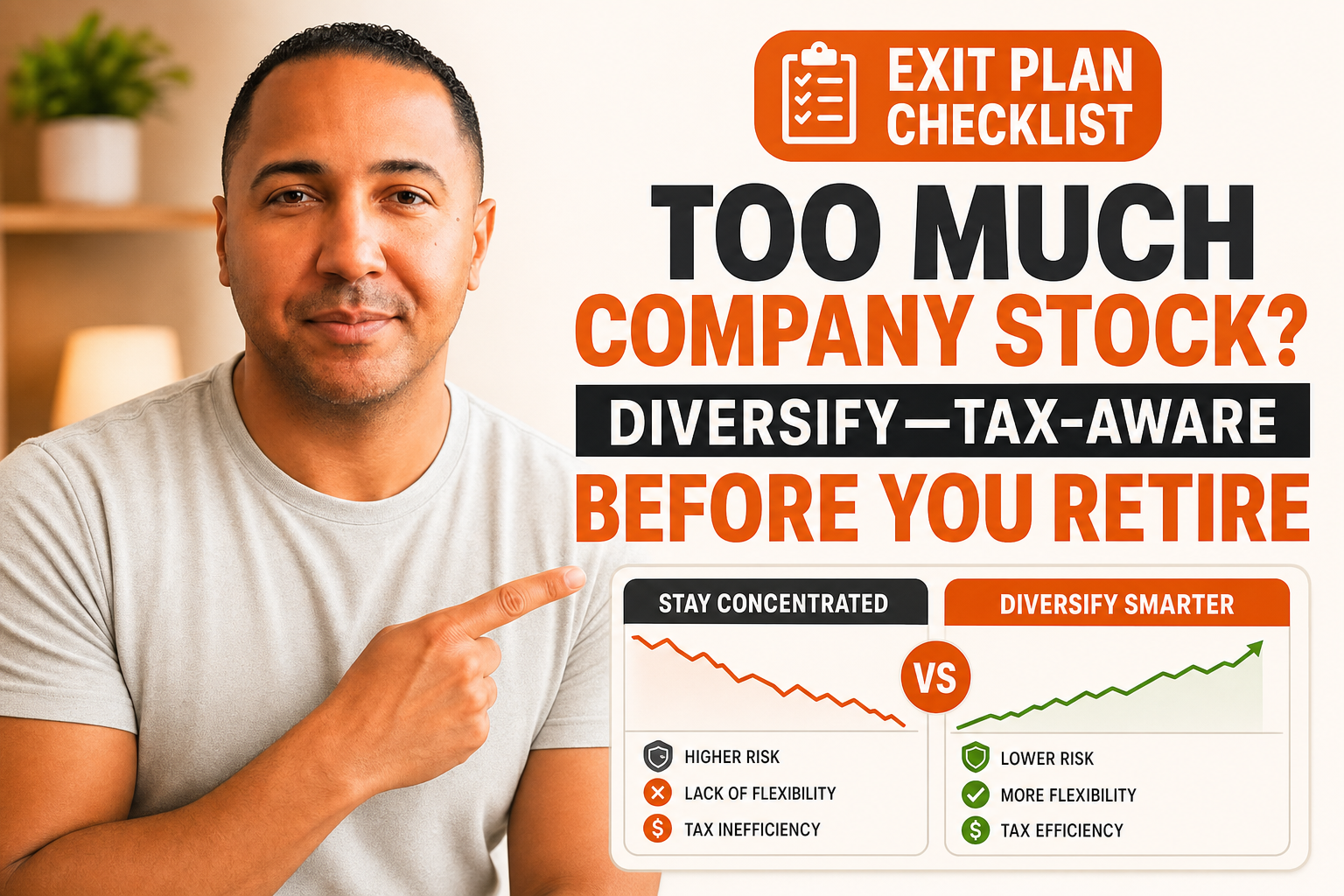
You can be “ready” for retirement on paper and still be taking one oversized, avoidable risk.
It usually shows up like this: you’ve saved well, you’ve built real wealth, and then you look under the hood and realize 30%, 50%, sometimes 70% of your investable assets are tied to one company stock. Often it’s your employer. Sometimes it’s the stock you bought years ago and never sold. And now you feel stuck between two fears: the fear of a big tax bill if you sell, and the fear of a big portfolio hit if you don’t.
Here’s the tension I want to name plainly: concentrated stock risk is a retirement risk, not just an “investment” risk. In retirement, you don’t get paid to wait. You’re drawing income, managing Medicare, deciding on Social Security, and trying to keep taxes predictable. A single bad year in a single stock can force you to sell at the wrong time, claim benefits earlier than planned, or abandon a spending plan you were excited about.
My goal in this guide is not to talk you into “dumping the stock.” My goal is to help you build a tax-aware exit plan that reduces single-stock risk in a controlled way, without accidentally blowing up your retirement income plan.
This is a supporting article inside our “Retirement Planning for $500K–$5M Households” cluster, and it ties directly into the bigger pillar topic of tax-smart retirement income planning. If you want the withdrawal sequencing framework that sits underneath many of the decisions in this article, see: /post/retirement-withdrawal-strategies-tax-smart-order-of-operations.
The real risk isn’t volatility—it’s concentration colliding with retirement cash flow
Most retirees think “risk” means the market going down.
Near retirement, risk is more specific:
- The risk that one stock drops at the exact moment you need to fund spending.
- The risk that you’re forced to sell when taxes are most expensive (or when selling triggers Medicare premium surcharges).
- The risk that your plan becomes dependent on one company’s management team, one product cycle, one lawsuit, one regulatory change, or one bad earnings call.
A diversified portfolio can have a bad year. A concentrated portfolio can have a life-changing year.
This is why I often tell clients: the question isn’t “Do you believe in the company?” The question is “Can your retirement succeed if this one stock gets cut in half and takes five years to recover?”
If you’re not sure what “too much” looks like, we wrote a dedicated piece to help you calibrate it: /post/single-stock-risk-in-retirement-how-much-is-too-much.
Here’s the part many smart people miss: concentration risk is not linear.
If 10% of your portfolio is in one stock, it’s a nuisance.
If 40% is in one stock, it’s a plan.
If 70% is in one stock, it’s a bet.
And retirement is not the stage of life where you want your lifestyle to depend on a bet.
First, identify what kind of concentrated position you actually have (because the tax rules change)
“Company stock” is not one thing. The account type and how you acquired the shares drives the tax strategy.
Here are the common buckets we see near retirement:
- Taxable brokerage shares (you bought shares, or shares were deposited from equity compensation)
- Selling can trigger capital gains tax.
- You can choose which tax lots to sell (high cost basis vs low cost basis).
2) RSUs (restricted stock units)
- RSUs are typically taxed as ordinary income when they vest.
- After vesting, any additional gain/loss is capital gain/loss.
- Many people accidentally “double down” because they don’t sell at vesting.
3) ESPP (employee stock purchase plan)
- Taxes depend on whether you meet holding requirements for a “qualifying disposition.”
- The discount can be taxed differently depending on timing.
4) Stock options (ISOs or NSOs)
- Options have their own tax rules and timing issues.
- Exercise decisions can create ordinary income or AMT exposure.
5) Company stock inside a 401(k) or other qualified plan
- This is where net unrealized appreciation (NUA) might apply.
- NUA can be powerful, but it’s easy to do incorrectly.
6) ESOP (employee stock ownership plan)
- ESOPs have specific diversification rights as you approach retirement.
- The plan rules matter, and the timing matters.
Why start here? Because “I’ll just sell some shares” can be a great plan in a taxable account and a terrible plan in a 401(k) if you accidentally destroy an NUA opportunity.
So before you take action, you want a simple inventory:
- Where are the shares held (taxable, IRA, 401(k), ESOP)?
- What is the cost basis (what you paid, or what the plan reports as basis)?
- What is the unrealized gain (current value minus basis)?
- Are there restrictions, blackout windows, or trading policies?
- Are you charitably inclined?
- What is your retirement timeline (this year, 2–3 years, 5+ years)?
That inventory becomes the foundation for everything else.
A tax-aware exit plan is really a sequencing plan (and the sequencing is the whole game)
Most people think diversification is a single decision: sell or don’t sell.
In reality, good concentrated-stock diversification near retirement is a multi-year sequence. You’re coordinating:
- Your income needs (how much cash you need, and when)
- Your tax brackets (ordinary income and capital gains)
- Medicare premiums (IRMAA)
- Social Security taxation
- RMD timing (required minimum distributions starting at age 73 for many retirees)
- Portfolio risk targets (how much you want in stocks vs bonds/cash)
When you sell a concentrated position, you’re not just changing your investments. You’re changing your tax return.
Here are the “tax levers” retirees run into most often, in plain English:
Capital gains tax
- If you sell shares in a taxable account for more than you paid, the profit is a capital gain.
- Long-term capital gains (shares held more than a year) are usually taxed at lower rates than ordinary income.
NIIT (Net Investment Income Tax)
- Higher-income households may pay an extra 3.8% tax on certain investment income.
Social Security taxation
- The more other income you have (including capital gains), the more of your Social Security can become taxable.
Medicare IRMAA
- Medicare Part B and Part D premiums can jump if your income crosses certain thresholds.
- A large stock sale can create a two-year-later Medicare premium surprise.
- We cover this interaction in detail here: /post/medicare-irmaa-capital-gains-roth-conversions.
RMDs
- Starting at age 73, many retirees must withdraw a minimum amount each year from pre-tax retirement accounts.
- RMDs add to taxable income and can crowd out “room” for capital gains or Roth conversions.
- More here: /post/rmd-planning-after-73-reduce-taxes.
A tax-aware exit plan uses these levers intentionally. A tax-blind exit plan trips over them.
A realistic example: the $2.4M household with $1.1M in one stock
Let’s make this concrete.
Mark (64) and Elena (62) are two years from retirement. They have about $2.4M invested:
- $1.1M in Mark’s employer stock in a taxable brokerage account (low cost basis; large unrealized gain)
- $900k in 401(k)/IRA assets
- $400k in a joint taxable account diversified across funds
They want to spend $110k/year after tax in retirement. They’re also trying to keep Medicare costs reasonable once they enroll.
Their problem is not that they own employer stock. Their problem is that their retirement plan is quietly dependent on one ticker symbol.
If that stock drops 40% in a recession, their $1.1M becomes $660k. That’s a $440k hit.
In the accumulation years, that’s painful.
In the retirement transition, it can be destabilizing:
- It may force higher withdrawals from the 401(k) earlier than planned.
- It may reduce flexibility for Roth conversions.
- It may push them to claim Social Security earlier.
- It may create “sell low” pressure to fund spending.
But if they sell the entire $1.1M in one year, the capital gains could be enormous. That could:
- Push them into higher tax brackets
- Trigger NIIT
- Increase the taxable portion of Social Security (if they’ve started benefits)
- Trigger Medicare IRMAA surcharges two years later
So the right answer is not “sell everything now” or “never sell.”
The right answer is a staged, tax-aware plan that reduces risk on purpose.
The diversification toolkit (ranked by what retirees tend to misunderstand)
There are many ways to reduce single-stock exposure. Some are straightforward. Some are advanced. Most are misapplied.
Below is the toolkit I use with households in the $500k–$5M range, with an editorial point of view on what’s underrated, overrated, and easy to get wrong.
Staged selling with tax-lot control (underrated)
This is the workhorse strategy.
Instead of one huge sale, you sell in planned tranches over multiple tax years. In a taxable account, you can often choose which “lots” to sell.
- Selling high-cost-basis shares first can reduce taxable gains.
- Selling enough each year to “fill up” a target tax bracket can keep taxes more predictable.
This is also where retirement income planning matters. If you’re retiring this year, your income may drop next year. That can create a window to realize gains at lower rates.
The mistake I see: people wait for the “perfect price,” then sell a massive amount in one year because they’re finally ready. That’s usually the most expensive way to do it.
Pairing sales with intentional losses elsewhere (useful, but not a magic wand)
If you have other investments that are down, selling them can create capital losses.
Capital losses can offset capital gains.
This is helpful, but it’s not unlimited. The rules are specific, and the best use is often tactical: you harvest losses in a down market year while also trimming the concentrated position.
The mistake I see: people assume losses will “erase” a huge gain. Sometimes they help. They rarely solve the entire problem.
Charitable gifting of appreciated shares (very powerful if you already give)
If you’re charitably inclined, donating appreciated shares can be one of the cleanest ways to diversify.
In plain English:
- You give shares (not cash) to a qualified charity.
- You may get a charitable deduction (subject to rules and limits).
- You avoid paying capital gains tax on the appreciation.
For many retirees, a donor-advised fund (DAF) is the practical tool. You can “front-load” several years of giving into one high-income year, take the deduction (if you itemize), and then grant to charities over time.
This is not a strategy to invent charitable intent. It’s a strategy to fund the giving you were already going to do, in a more tax-efficient way.
Covered calls and collars (can reduce risk, but complexity is real)
Options-based strategies can sometimes reduce downside risk or generate income.
- A covered call means you sell someone else the right to buy your stock at a set price. You collect a premium.
- A collar typically combines selling a covered call and buying a protective put, creating a range of outcomes.
These can be useful when:
- You’re restricted from selling immediately
- You want to reduce downside risk during a staged exit
- You need time to spread gains across tax years
But options are not “free money.” They can cap upside, create tax complications, and require careful implementation.
The mistake I see: retirees using covered calls as a substitute for diversification. Options can be a bridge. They are rarely the destination.
Exchange funds (niche, sometimes appropriate, often oversold)
Exchange funds allow investors with concentrated positions to pool their stock with others and receive a diversified basket, typically with a long holding period.
These can be useful for very large positions where taxes make selling painful and the investor can tolerate:
- Lockups (often years)
- Fees and complexity
- Limited liquidity
This is not a mainstream solution for most retirees. It’s a specialized tool.
“Just hold it, it’s a great company” (overrated)
I’m not saying the company isn’t great.
I’m saying your retirement plan shouldn’t depend on it.
A great company can still have a terrible decade for shareholders. Or it can have one catastrophic event. Concentration turns that event into a lifestyle problem.
NUA, ESOP rules, and the IRS guidelines retirees actually need to know
This is the part where a lot of households accidentally step on a landmine.
NUA (Net Unrealized Appreciation) in a 401(k): potentially huge, but easy to ruin
If you have employer stock inside a qualified plan (like a 401(k)), NUA may allow favorable tax treatment.
Plain-English version:
- The “cost basis” of the shares inside the plan is what the plan paid for them.
- The “NUA” is the growth above that basis.
- Under the right conditions, you can distribute the shares out of the plan “in-kind” (as shares, not cash).
- You generally pay ordinary income tax on the cost basis at distribution.
- The NUA portion is not taxed at distribution; it’s taxed later when you sell the shares, typically at long-term capital gains rates.
That difference can be meaningful.
But details matter: timing, triggering events, and how you move the rest of the plan assets can affect eligibility. If you roll the shares to an IRA first, you may lose the NUA opportunity.
If NUA might apply to you, read our dedicated guide before you do anything: /post/nua-company-stock-401k-retirement.
Also: NUA is not automatically “best.” Sometimes paying ordinary income on the basis now increases your income enough to trigger Medicare IRMAA or other tax costs. It requires a full analysis.
ESOP diversification requirements: you may have rights you’re not using
If you’re in an ESOP, there are rules designed to give participants a chance to diversify as they near retirement.
In general terms, for many ESOPs:
- Participants who meet certain age and service requirements must be offered the ability to diversify a portion of their ESOP account.
- The required diversification election is at least 25% of the account balance during the election period, increasing to 50% in the final year of that period for applicable shares.
Your specific plan document controls the mechanics, and not every ESOP situation is identical. But the big point is this: if you’re close to retirement and still 100% concentrated in employer stock inside an ESOP, it’s worth asking what diversification elections you’re eligible to make.
IRS guidelines for diversifying employer stock in retirement accounts: the practical takeaway
Most retirees don’t need to memorize IRS publications. You need to know what decisions are irreversible.
The practical guidelines:
- Understand whether your employer stock is in a taxable account or a qualified plan.
- If it’s in a qualified plan, do not assume a rollover to an IRA is always the right first move.
- If NUA is in play, sequence matters.
- If you’re in an ESOP, ask about diversification elections and deadlines.
This is exactly the kind of situation where a fiduciary advisor and your CPA should coordinate before you execute.
Retirement-specific tripwires: Medicare, Social Security, and RMDs can turn a “good sale” into a bad year
A concentrated-stock exit plan that ignores retirement timing is incomplete.
Here are the tripwires I see most often.
Medicare IRMAA: the two-year echo
Medicare premiums are based on your income from two years prior.
So if you sell a large amount of appreciated stock at 63, you might feel fine at 63.
Then at 65, your Medicare Part B and Part D premiums jump.
This is one reason staged selling is so effective: it can keep you below certain income thresholds (or at least help you choose when you cross them).
If you want to understand how capital gains and Roth conversions can trigger IRMAA, see: /post/medicare-irmaa-capital-gains-roth-conversions.
Social Security taxation: gains can make benefits more taxable
Social Security has its own set of rules for how much of your benefit becomes taxable.
When you add other income—especially large capital gains—you can push more of your Social Security into the taxable column.
That doesn’t mean “never sell after you start Social Security.” It means you should model the interaction.
Sometimes the cleanest window to diversify is the gap between retirement and claiming Social Security.
RMDs at 73: the clock starts whether you’re ready or not
RMDs force taxable income out of pre-tax accounts.
If you wait to diversify until after RMDs begin, you may find you have less flexibility:
- RMDs fill up tax brackets.
- That can make capital gains more expensive.
- It can reduce room for Roth conversions.
If RMD planning is part of your situation, this article goes deeper: /post/rmd-planning-after-73-reduce-taxes.
The “withdrawal order” connection
When you sell concentrated stock, you’re often creating cash. The question becomes: what bucket should fund your spending?
If you want the broader framework for which accounts to draw from first (and why), see our pillar: /post/retirement-withdrawal-strategies-tax-smart-order-of-operations.
This matters because many concentrated-stock households have a weird imbalance:
- Too much in one taxable stock position
- A large pre-tax 401(k)
- Not enough in Roth or cash
A good exit plan often improves that balance over time.
The questions retirees are asking right now (and my direct answers)
“How can I reduce risk from holding too much company stock as I approach retirement?”
Start by separating emotion from math.
- Decide what percentage you’re willing to have in one stock after you retire.
- Then build a timeline to get there.
For most households, the best first move is not a dramatic sale. It’s a written plan: staged selling targets, tax bracket targets, and a reinvestment plan so the proceeds don’t sit in cash indefinitely.
If you’re still working at the company, also review trading windows and any restrictions.
“What are tax-efficient strategies for diversifying a concentrated stock position?”
The most consistently effective strategies are:
1) Multi-year staged selling using tax-lot selection
- Coordinating sales with lower-income years (often the early retirement window)
- Charitable gifting of appreciated shares (DAF or direct gifts)
- NUA analysis if the shares are in a 401(k)
Options strategies can help in specific cases, but they’re not the default.
“How do net unrealized appreciation rules affect my retirement planning?”
NUA can change the tax character of growth on employer stock inside a 401(k): from ordinary income rates to long-term capital gains rates on the appreciation.
That can be a major tax savings.
But it can also raise your income in the year you execute it (because the basis is taxed as ordinary income), which can affect Medicare and other planning items.
If NUA might apply, don’t guess. Analyze it. And don’t roll the shares to an IRA before you understand the consequences.
More here: /post/nua-company-stock-401k-retirement.
“What are the IRS guidelines for diversifying employer stock in retirement accounts?”
The key guidelines are less about “diversify” and more about “follow the rules of the account.”
- In a taxable account, you can sell anytime (subject to trading restrictions if you’re an insider).
- In a qualified plan, distributions and rollovers have rules, and NUA may apply to employer stock.
- In an ESOP, you may have diversification rights as you near retirement, and the plan must follow required rules for eligible participants.
If your employer stock is inside a retirement plan, treat it as a specialized planning area, not a routine trade.
Building your personalized exit plan: a simple framework that actually works
Here’s the framework I use with clients because it forces the right decisions in the right order.
Step 1: Set the “end state” (what diversification looks like for you)
Answer two questions:
- In retirement, what is the maximum percentage you want in any single stock?
- How much cash do you want set aside for near-term spending (often 12–24 months, depending on your plan)?
This is not about predicting the market. It’s about defining a risk boundary.
Step 2: Map the shares by account type and tax impact
Create a one-page map:
- Taxable shares: value, basis, unrealized gain, long-term vs short-term
- 401(k) shares: value, plan basis, potential NUA
- ESOP shares: value, diversification election eligibility and deadlines
- RSUs/ESPP: expected future vesting/purchase schedule
This is where many plans get sharper: you realize you’re not just concentrated today—you’re scheduled to become more concentrated through future vesting.
Step 3: Choose your “tax budget” by year
Instead of asking “How many shares should I sell?” ask:
- How much taxable income can we afford this year without triggering avoidable costs?
That includes:
- Ordinary income bracket targets
- Capital gains targets
- Medicare IRMAA thresholds (if relevant)
- NIIT exposure
This is also where Roth conversions can fit. In some households, you can pair moderate stock sales with moderate Roth conversions over multiple years. In others, doing both in the same year is too much income.
If you want to understand when Roth conversions help near retirement, see: /post/roth-conversions-near-retirement-when-they-help.
Step 4: Decide what’s being diversified into (don’t skip this)
Selling is only half the decision.
What are you buying with the proceeds?
A retirement portfolio needs a job description:
- A portion for near-term spending stability (cash/bonds)
- A portion for long-term growth (diversified stocks)
- A portion for inflation protection
This is where “retirement portfolio diversification” becomes real. You’re not diversifying for the sake of it. You’re building a portfolio that can fund withdrawals through good markets and bad.
Step 5: Put guardrails in writing
Your plan should include:
- A target reduction schedule (example: reduce from 45% to 25% over 24 months)
- A maximum “do nothing” threshold (example: if it rises above 35% again due to price appreciation, trim)
- A rule for windfalls (RSU vesting, bonuses, special dividends)
Written guardrails reduce regret. They also reduce the temptation to turn every decision into a market forecast.
A practical action list (what I’d do in the next 30 days if this is you)
If you’re within five years of retirement and a single stock is a major piece of your net worth, here’s your next-step list.
1) Calculate your concentration percentage two ways
- Percentage of investable assets
- Percentage of the assets that will fund retirement spending (sometimes a rental property or pension changes the picture)
2) Gather the right documents
- Most recent brokerage statement showing cost basis and lots
- 401(k) statement showing employer stock holdings and plan basis (if available)
- Equity compensation statements (RSU/ESPP/option details)
- ESOP plan diversification notices (if applicable)
3) Identify your “best tax window”
- Are you retiring soon (income drop coming)?
- Are you delaying Social Security (lower taxable income window)?
- Are RMDs approaching (less flexibility later)?
4) Stress-test the stock against your retirement income plan
- What happens if the stock drops 30% next year?
- What changes in withdrawals, Social Security timing, or spending?
5) Decide whether NUA needs to be analyzed before any rollover
- If employer stock is in a 401(k), pause before rolling to an IRA.
- Read: /post/nua-company-stock-401k-retirement.
6) If you’re charitably inclined, explore gifting shares
- Consider whether a donor-advised fund fits your giving pattern.
- Coordinate with your CPA on deduction limits and documentation.
7) Build a one-page “sell plan” with your CPA/advisor
- Target dollar amounts per year
- Which lots to sell
- How proceeds will be reinvested
- How you’ll monitor Medicare IRMAA exposure
If you do nothing else, do this: stop treating the decision like a single trade and start treating it like a multi-year plan.
The point of view I’ll leave you with
Concentrated stock positions are often built honestly: loyalty to an employer, a long run of success, a compensation plan that kept paying in shares, and a busy life.
But retirement changes the math.
In retirement, your portfolio isn’t a scoreboard. It’s a supply chain. It supplies your spending, your tax flexibility, and your peace of mind.
A tax-aware exit plan is not about being clever. It’s about being intentional.
If you want help building a fiduciary, tax-aware concentrated-stock exit plan that coordinates investment risk reduction with retirement income, Medicare, Social Security timing, and multi-year tax planning (in collaboration with your CPA), book an appointment here: http://grapewealthmanagement.salesmate.io/meetings/#/grapewealthmanagement/user/1