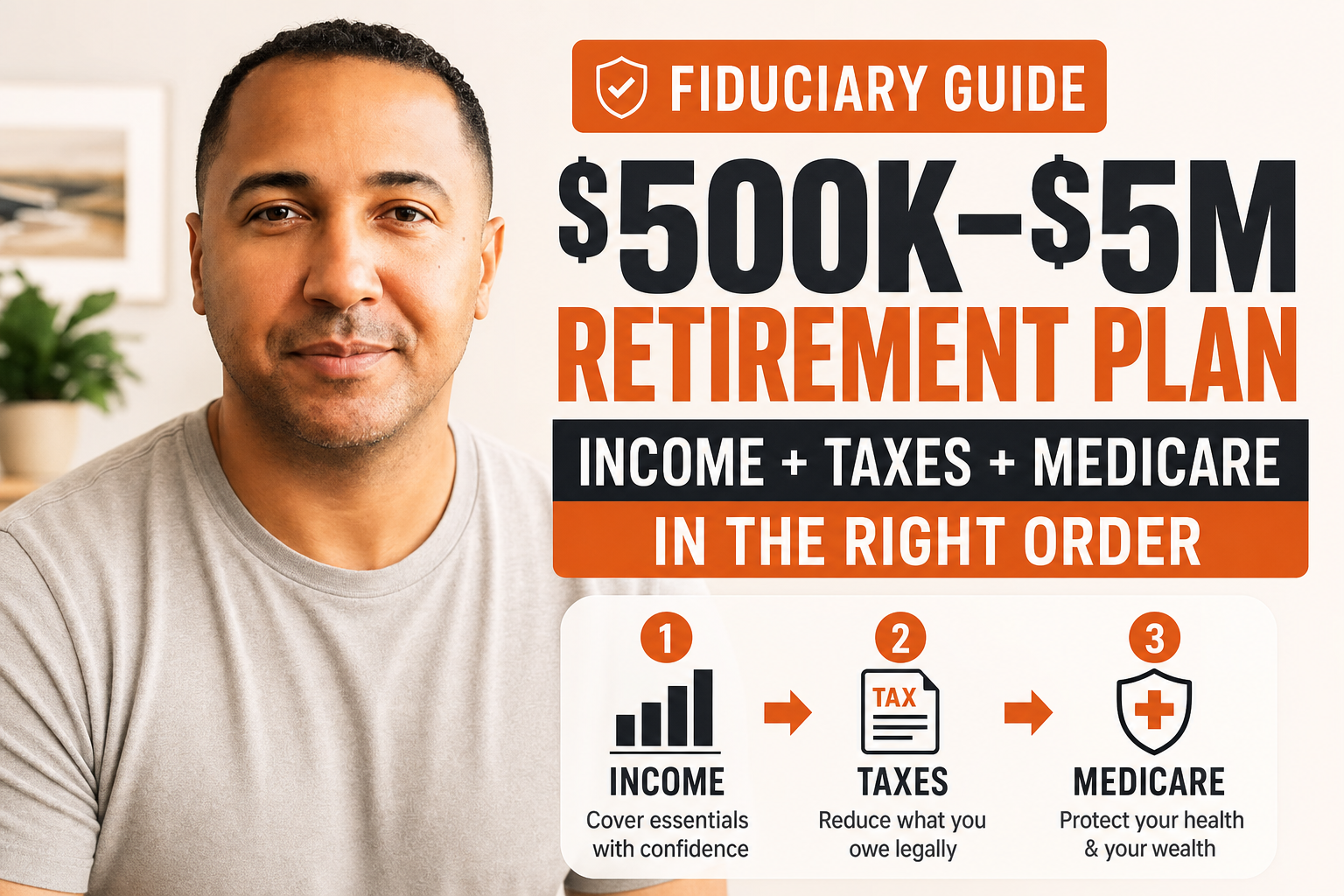
You did the hard part: you saved real money. Now comes the part that surprises almost everyone—every retirement decision is connected.
Claim Social Security and you change your tax picture. Sell a position in your brokerage account and you might trigger Medicare premium surcharges two years later. Convert to Roth and you could lower future RMDs, but you might also push yourself into a higher tax bracket today. Even “simple” choices like which account to spend from can quietly cost (or save) tens of thousands of dollars over a long retirement.
I’m Alex Newman with Grape Wealth Management. In this guide, I’m going to give you a decision-sequencing framework for retirement planning for $500K–$5M households—people who are close to retirement or newly retired, with meaningful assets, but who want plain-English clarity. The goal isn’t to optimize one thing. The goal is to build a plan that holds up when markets wobble, taxes change, and life gets messy.
This is a pillar resource for our Retirement Planning for $500K–$5M Households cluster. I’ll reference a few deeper-dive articles along the way so you can go further where it matters most.
The retirement tradeoff most people miss: you can’t optimize everything at once
Most retirees walk in thinking the job is to “get the best return” or “pay the least tax.” Those are pieces of the puzzle, but they’re not the puzzle.
In real retirement planning, you’re balancing three forces that often conflict:
Income stability: predictable cash flow so you can live your life.
Tax efficiency: paying the right amount of tax over your lifetime, not just this year.
Flexibility: keeping options open for big purchases, helping family, or healthcare surprises.
Here’s the uncomfortable truth: you usually can’t maximize all three at the same time.
For example, delaying Social Security can increase lifetime guaranteed income (stability), but it may require larger portfolio withdrawals in your 60s (less stability early on) and can change your tax and Roth conversion opportunities (tax efficiency).
Or, doing aggressive Roth conversions can reduce future RMDs (tax efficiency and flexibility later), but it can raise your current taxable income and potentially increase Medicare premiums (less tax efficiency and less flexibility in the short run).
A good plan makes these tradeoffs on purpose, in the right order, with your real goals in mind.
The order-of-operations framework (the sequence matters)
When households have $500K–$5M invested, the biggest mistakes I see aren’t “bad funds” or “wrong stocks.” They’re sequencing mistakes—doing the right move at the wrong time.
Here’s the sequence I use in planning conversations. We’ll unpack each step.
- Define your spending target and build an income floor
- Decide Social Security timing (especially for couples)
- Coordinate Medicare enrollment and manage IRMAA risk
- Build a tax-efficient withdrawal plan and identify Roth conversion windows
- Set portfolio risk with guardrails (so you can stay invested)
- Plan ahead for RMDs at 73 and charitable options
- Coordinate estate basics with beneficiary designations and account structure
If you only take one thing from this article, take this: retirement planning isn’t a list of independent tasks. It’s a connected system.
From “How much can I spend?” to building an income floor you can trust
Before we talk about taxes or investments, we need to talk about cash flow.
Most near-retirees underestimate how much clarity they can get from a simple question:
What do you want retirement to cost, in today’s dollars, after tax?
Not your pre-tax “budget.” Not a vague lifestyle description. A real number.
Then we separate your spending into two buckets:
Needs: housing, utilities, groceries, insurance, basic travel, healthcare.
Wants: bigger travel, gifting, hobbies, second home expenses, renovations.
This matters because “needs” are what we want to fund with the most reliable sources.
What is an income floor?
An income floor is the portion of your retirement spending covered by predictable income sources. Typically:
Social Security
Pensions (if you have one)
Annuity income (sometimes appropriate, sometimes not)
Bond interest or a structured withdrawal plan (less guaranteed, but can be stabilized)
The higher your income floor relative to your needs, the less you’ll feel forced to sell investments at a bad time.
A realistic example (within the $500K–$5M range)
Let’s use a household I’ll call Mark and Denise:
Both age 64, retiring this year
$1.6M invested: $900K in traditional IRAs/401(k)s, $450K in a brokerage account, $250K in Roth IRAs
No pension
They want $110,000 per year after tax to live comfortably
They’re healthy, but Denise’s family history suggests higher healthcare costs later
Here’s the tension: if they claim Social Security early, they reduce the need to draw from investments now, but they lock in a smaller lifetime benefit. If they delay, they may be able to do Roth conversions in a lower tax bracket, but they’ll need to fund more spending from the portfolio in their mid-60s.
This is why we start with the income floor and spending target. It tells us what the plan must accomplish.
What changes at $500K vs. $5M
At around $500K–$1M, the plan is usually more sensitive to sequence-of-returns risk (bad markets early in retirement) and to claiming decisions. A “small” mistake can permanently change lifestyle.
At $3M–$5M, lifestyle may be secure, but taxes, Medicare IRMAA, RMDs, and estate outcomes often become the dominant risks. The question shifts from “Will we run out?” to “Are we leaking value through avoidable taxes and poor coordination?”
Social Security: the most valuable inflation-adjusted paycheck you can buy
Social Security is not just “a benefit.” For most retirees, it’s the only inflation-adjusted income stream backed by the U.S. government.
Two simple terms that matter:
Full Retirement Age (FRA): the age when you get your “standard” benefit (often 66–67 depending on birth year).
Delayed Retirement Credits: if you delay past FRA, your benefit grows (roughly 8% per year until age 70, not counting cost-of-living adjustments). The Social Security Administration explains the delay credits here: https://www.ssa.gov/benefits/retirement/planner/delay.html
The tradeoff is straightforward:
Claim earlier: more checks, sooner, but smaller monthly amount for life.
Claim later: fewer checks early, but larger monthly amount for life.
What’s underrated: Social Security as longevity insurance
People obsess over “break-even age.” That’s not useless, but it’s not the main point.
The bigger issue is longevity risk—living longer than expected. If you or your spouse lives into your late 80s or 90s, a higher guaranteed monthly benefit can reduce pressure on your portfolio when you’re older and less able (or willing) to adapt.
Couples: the survivor benefit is the hidden lever
For married couples, one of the most important planning facts is this:
When one spouse dies, the household keeps the larger of the two Social Security benefits (not both).
So the higher earner delaying can protect the surviving spouse.
If you want a deeper dive, we have a dedicated supporting article here: /post/blog-social-security-optimization-for-couples
How Social Security affects taxes (plain English)
Social Security can be partially taxable depending on your total income. The key point is that adding withdrawals from IRAs or realizing capital gains can cause more of your Social Security to be taxed.
This is one reason we coordinate Social Security timing with withdrawal strategy and Roth conversions. You’re not just choosing a benefit date. You’re choosing a tax pattern.
Medicare: enrollment timing, plan choice, and the IRMAA trap
Medicare is where I see smart people make expensive mistakes—not because they’re careless, but because the rules are unintuitive.
Three Medicare basics
Medicare Part A: hospital coverage (often premium-free if you have enough work history).
Medicare Part B: doctor/outpatient coverage (has a monthly premium).
Medicare Part D: prescription coverage (has a monthly premium).
Then you choose how you receive coverage:
Original Medicare plus a Medigap supplement (and usually Part D)
Or Medicare Advantage (a private plan that replaces Original Medicare for most services)
If you want the timeline and plan-choice breakdown, see our supporting guide: /post/blog-medicare-enrollment-timeline-medigap-vs-advantage
The two-year lookback that surprises retirees: IRMAA
IRMAA is an extra surcharge added to Medicare Part B and Part D premiums if your income is above certain thresholds.
Plain English: higher income today can raise your Medicare premiums later.
And “income” here is based on your tax return (specifically modified adjusted gross income). Big one-time events can trigger it:
Large Roth conversions
Selling a highly appreciated investment
Taking large IRA withdrawals
Selling a business or property
This is why I treat Medicare as part of tax planning, not just healthcare planning.
We have a deeper article on this here: /post/blog-irmaa-medicare-premium-surcharges-planning
A practical way to think about Medicare decisions
If you value broad provider access and predictability, Original Medicare plus Medigap is often attractive.
If you’re comfortable with networks and want potentially lower premiums, Medicare Advantage can fit.
There’s no universal “best.” But there is a best fit for your travel habits, health profile, and risk tolerance for out-of-pocket variability.
Tax-efficient withdrawals: the retirement paycheck you build yourself
Once you retire, you become your own payroll department.
The core question is not “How do I get money out?” It’s:
How do I create the spending I need while controlling taxes over decades?
The three-bucket tax reality (simple version)
Most retirees have money in three tax “buckets”:
Taxable (brokerage): you may owe tax on dividends, interest, and capital gains. Selling can create capital gains.
Tax-deferred (traditional IRA/401(k)): withdrawals are generally taxed as ordinary income.
Tax-free (Roth): qualified withdrawals are generally tax-free.
Your withdrawal strategy is how you mix these buckets year by year.
Why the “just take 4%” approach is incomplete
A withdrawal rate rule of thumb doesn’t tell you:
Which account to pull from
How to manage taxes and Medicare premiums
How to handle large one-time expenses
How to adjust in down markets
You need a withdrawal plan, not a slogan.
A workable order-of-operations (and when to break it)
Many households benefit from a general sequence like:
Use taxable assets strategically (especially lots with high cost basis)
Fill lower tax brackets with IRA withdrawals or Roth conversions
Preserve Roth assets for later years or heirs when appropriate
But the right order depends on your tax bracket, pension/Social Security timing, and RMD outlook.
We go deeper on the mechanics here: /post/blog-tax-efficient-retirement-withdrawal-strategies-order-of-operation
The Roth conversion window: a narrow opportunity many retirees miss
A Roth conversion means moving money from a traditional IRA to a Roth IRA and paying tax now, in exchange for potentially lower taxes later.
The best time to consider conversions is often:
After you retire but before RMDs start at 73
And sometimes before Social Security begins
Why? Because you may have a few years with unusually low taxable income. That can let you “fill up” lower tax brackets with conversions.
But conversions can also:
Increase IRMAA Medicare premiums
Increase taxation of Social Security (if benefits have started)
Push you into higher brackets
This is why conversions should be modeled, not guessed.
Supporting deep dive: /post/blog-roth-conversions-early-retirement-window-irmaa
Portfolio risk in retirement: the goal is staying power, not bragging rights
In your working years, volatility is mostly emotional. In retirement, volatility becomes math.
Sequence-of-returns risk (plain English)
If markets drop early in retirement and you’re withdrawing to live, you may be forced to sell more shares at low prices. That can permanently damage the portfolio’s ability to recover.
This is why retirees can’t manage risk the same way as accumulators.
What’s overrated: “conservative” portfolios that quietly fail
Many retirees hear “conservative” and think “safe.” But a portfolio that’s too conservative can fail in a different way: it may not keep up with inflation and spending over a 25–35 year retirement.
Safety isn’t just avoiding a market drop. Safety is maintaining purchasing power and avoiding forced decisions.
What’s underrated: guardrails and a real cash plan
A durable retirement portfolio usually includes:
A clear spending policy (what you withdraw and from where)
A cash or short-term bond reserve sized to your plan (not a random number)
A diversified mix of stocks and bonds aligned to your ability to stay invested
Guardrails: pre-decided adjustments if markets fall or if spending rises
Guardrails aren’t about panic. They’re about removing guesswork.
How risk decisions change from $500K to $5M
Closer to $500K–$1M: you may need tighter spending discipline, a stronger income floor, and more careful downside planning.
Closer to $5M: you may have more ability to take market risk, but you also have more tax exposure and often more complex goals (gifting, legacy, charitable intent). Risk management becomes as much about taxes and concentration risk as it is about stock/bond mix.
RMDs at 73: the tax event you can see coming (so plan for it)
Required Minimum Distributions (RMDs) are mandatory withdrawals from most tax-deferred retirement accounts.
Current rule of thumb: RMDs generally begin at age 73 for many retirees (based on current law). The IRS provides guidance here: https://www.irs.gov/retirement-plans/plan-participant-employee/retirement-topics-tax-on-early-distributions
Plain English: the government let you delay taxes for years, but eventually it requires you to start taking money out and paying ordinary income tax.
Why RMDs matter even if you don’t need the money
If you don’t need the RMD to live, you still must take it (with limited exceptions). That can:
Push you into higher tax brackets
Increase taxation of Social Security
Trigger or increase IRMAA Medicare surcharges
Increase taxes on survivors (especially if a spouse dies and the survivor files single)
This is why we plan for RMDs years in advance.
Two powerful levers: pre-RMD Roth conversions and QCDs
Pre-RMD Roth conversions can reduce future RMDs by shrinking the traditional IRA balance.
Qualified Charitable Distributions (QCDs) allow eligible retirees (generally age 70½ or older) to give directly from an IRA to a qualified charity, potentially satisfying RMD requirements while reducing taxable income.
QCD rules have details and must be done correctly.
We cover RMD planning and QCD strategy here: /post/blog-rmd-rules-tax-planning-qcd
Estate basics for retirees: the simple coordination that prevents big messes
When people hear “estate planning,” they often think “I need a trust.” Sometimes you do. Sometimes you don’t.
But every retiree with meaningful assets needs coordination.
Three estate concepts that matter in retirement
Beneficiary designations: who receives your IRA, 401(k), Roth IRA, and life insurance. These often override your will.
Titling: how your accounts are owned (individual, joint, trust).
Tax rules for inherited accounts: especially after recent rule changes, many non-spouse heirs may have to withdraw inherited retirement accounts within a set period, potentially creating a tax spike.
What’s misunderstood: “My will covers everything”
A will is important. But many of your largest assets transfer by beneficiary form or account title.
A common, painful example: an old 401(k) beneficiary form naming an ex-spouse, or naming “my estate” unintentionally, which can create probate and tax complications.
What to coordinate (without overcomplicating it)
At minimum, I want retirees to review:
Primary and contingent beneficiaries on all retirement accounts
Payable-on-death and transfer-on-death designations on taxable accounts
Powers of attorney (financial and healthcare)
A plan for how the surviving spouse will manage finances
If you have $2M–$5M, own property in multiple states, have a blended family, or have charitable goals, it’s often worth discussing trust planning with an estate attorney. As your advisor, my job is to coordinate with that attorney and your CPA so the plan is consistent.
The questions retirees are asking right now (and my straight answers)
How can I optimize my Social Security benefits during retirement?
Start with your household goals: do you need income now, or can you fund early retirement years from the portfolio? For couples, prioritize the higher earner’s decision because of the survivor benefit. Then model taxes and Medicare impacts. If you want a focused couples framework, see /post/blog-social-security-optimization-for-couples.
What are the best strategies for withdrawing funds from my retirement accounts?
The best strategy is the one that coordinates taxes, Medicare premiums, and market risk. Many retirees benefit from a planned mix of taxable withdrawals, IRA distributions, and Roth withdrawals rather than draining one account at a time. The “right” plan often changes at 73 when RMDs begin. For a deeper order-of-operations discussion, see /post/blog-tax-efficient-retirement-withdrawal-strategies-order-of-operation.
How can I minimize taxes on my retirement income?
Think in terms of lifetime taxes, not just this year. The biggest levers are:
Social Security timing
Roth conversion planning in low-income years
Capital gains management in taxable accounts
Charitable strategies like QCDs (if you give)
Managing IRMAA thresholds
This is exactly why we treat retirement as a tax planning problem with an investment component, not the other way around.
What are the required minimum distributions for my retirement accounts?
RMDs are required withdrawals from most traditional retirement accounts starting at age 73 for many retirees under current law. The amount is based on IRS life expectancy tables and your account balance. Missing an RMD can trigger penalties, so we build an RMD calendar and integrate it into the tax plan. More here: /post/blog-rmd-rules-tax-planning-qcd.
How can I plan my estate to benefit my heirs?
Start with beneficiary designations and account structure. Then decide what you’re trying to accomplish: equal inheritance, tax-efficient inheritance, protecting a spouse, supporting a child with special circumstances, charitable giving, or reducing family conflict. Often the best “estate plan” is a coordinated set of beneficiary forms, a clear plan for taxes on inherited accounts, and updated legal documents.
A practical action list: your Retirement Readiness & Tax-Smart Withdrawal Review
If you’re within five years of retirement or you’ve retired in the last few years, here’s the checklist I’d use to pressure-test your plan. You don’t need to do it all in one weekend, but you do need to do it deliberately.
Clarify the target
Write down your annual spending target after tax.
Separate needs vs. wants.
List one-time expenses you expect in the next 5–10 years (roof, car, travel, helping family).
Build the income map
List guaranteed income sources (Social Security, pension).
Decide what portion of needs should be covered by predictable income.
Identify the gap your portfolio must fill.
Lock in the big enrollment decisions
Confirm your Medicare enrollment dates and avoid late-enrollment penalties.
Choose between Original Medicare plus Medigap vs. Medicare Advantage based on your real priorities.
Estimate IRMAA exposure before doing large conversions or asset sales. Use /post/blog-irmaa-medicare-premium-surcharges-planning as a guide.
Create a withdrawal and tax roadmap
Decide your withdrawal order across taxable, traditional, and Roth accounts.
Identify potential Roth conversion years and set a target tax bracket to “fill.”
Coordinate conversions with Medicare and Social Security timing. See /post/blog-roth-conversions-early-retirement-window-irmaa.
Set portfolio guardrails
Confirm your stock/bond mix matches your ability to stay invested during a downturn.
Establish a cash/short-term reserve tied to your spending plan.
Define what changes (and what doesn’t) if markets drop 15% or 25%.
Get ahead of RMDs and legacy planning
Project RMDs starting at 73 and test the tax impact.
If you give to charity, evaluate QCDs. See /post/blog-rmd-rules-tax-planning-qcd.
Review beneficiaries on every account and update outdated forms.
Coordinate with your estate attorney and CPA so the plan matches the documents.
One last perspective: the best plan is the one you can actually follow
In the $500K–$5M range, the “math” is usually solvable. The harder part is building a plan that fits your behavior.
If you’re the type of person who will lose sleep when the market drops, you need a portfolio and income plan designed for that reality. If you’re highly tax-sensitive, we can often reduce lifetime taxes—but only if we coordinate Social Security, Medicare, and withdrawals instead of treating them as separate projects.
Retirement planning for $500K–$5M households is not about finding one perfect trick. It’s about sequencing the right decisions so your income is durable, your taxes are intentional, and your options stay open.
If you want help building your own coordinated roadmap, book a Retirement Readiness & Tax-Smart Withdrawal Review with Grape Wealth Management here: http://grapewealthmanagement.salesmate.io/meetings/#/grapewealthmanagement/user/1