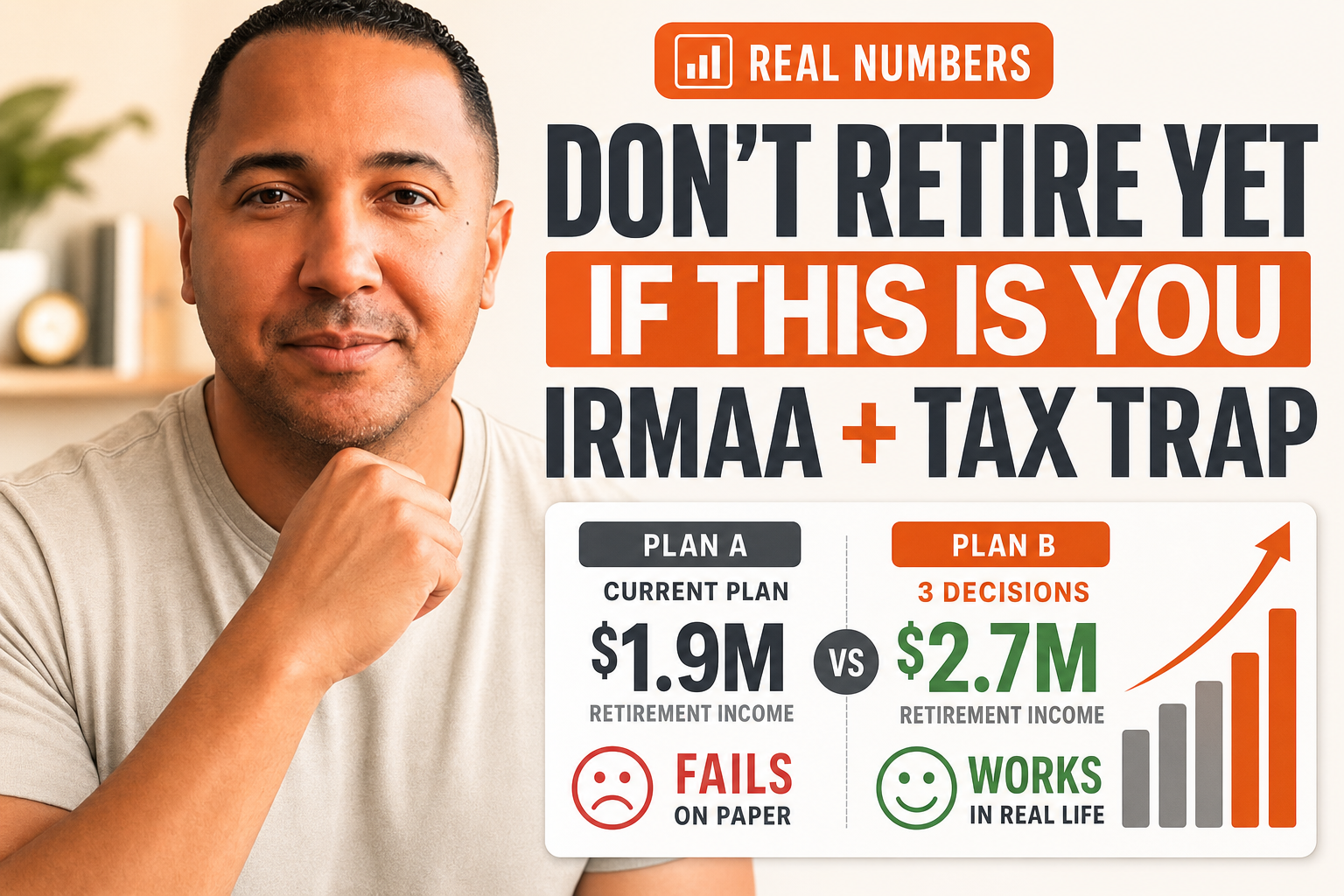
You can be “ready” for retirement on paper and still be one decision away from turning a good plan into an expensive one.
I see this all the time: a household with roughly $900,000 to $2.8M saved feels financially fine, work is getting old, and the instinct is to pick a date and make it official. But the first 3–5 years after you stop working are where the biggest, most avoidable mistakes happen—because taxes, Social Security, Medicare, and portfolio risk all collide at once.
In this case study, I’m going to walk you through an anonymized couple with about $1.9M. We’ll compare two retirement start dates, two Social Security claiming paths, and two withdrawal sequences. I’ll show you the specific planning “pressure points” that made me say, in plain English: you can retire soon, but don’t retire yet—not until we clean up the tax and Medicare math.
This is not about fear. It’s about coordination.
The household: strong balance sheet, fragile first draft
Meet “Mark (63) and Elena (62).” Married filing jointly. No pension. Healthy. They want to travel while they’re active and keep life simple.
They came in with what most people would call a great situation:
- Investable assets: about $1.9M
- Home: paid off (not included in investable assets)
- Debt: none
- Goal: retire now, spend about $120,000/year after tax (including travel), and keep a comfortable cushion
Here’s the part that created the tension: their savings were solid, but their account mix and income timing made them a prime candidate for accidentally triggering higher lifetime taxes and Medicare premium surcharges.
Their account structure (the “tax mix”)
- Taxable brokerage: $620,000
- Cost basis: $420,000 (meaning about $200,000 of unrealized long-term gains)
- Traditional IRA / 401(k): $1,050,000
- Roth IRA: $180,000
- Cash: $50,000
Their portfolio risk (before planning)
- 72% stock / 28% bonds/cash
- Concentration: about $160,000 in one legacy stock position inside the taxable account
That stock-heavy allocation isn’t “wrong.” But it matters a lot when you’re about to start withdrawals. The first few years of retirement are when a bad market can do the most damage, because you’re selling while the portfolio is down.
If you want the full framework we use to coordinate income, taxes, Medicare, and risk for households in this range, it’s outlined here: /post/retirement-planning-500k-5m-income-framework.
The planning tension: the same $1.9M can produce very different after-tax retirement
Mark and Elena’s first draft plan was simple:
- Retire now.
- Start Social Security early (because “we paid in, we should take it”).
- Pull the rest from the IRA as needed.
That plan is common. It’s also where high-net-worth retirement planning gets misunderstood.
When your assets are meaningful, the goal isn’t just “make the money last.” The goal is to:
- Create predictable spending cash flow
- Keep taxes intentionally low over decades (not just this year)
- Avoid Medicare IRMAA surprises (those income-based premium surcharges)
- Reduce the chance a bad market early in retirement forces permanent cutbacks
Here’s what tends to be overrated:
- Optimizing one variable in isolation (only Social Security, only Roth conversions, only investment returns)
Here’s what’s underrated:
- The first 3–5 years as a planning window
- MAGI management (the income number Medicare uses)
- Withdrawal sequencing (which account you pull from first)
Now let’s put numbers to it.
Assumptions (so you can judge the math)
I’m going to keep this transparent and simple. Real plans have more moving parts, but the point here is the decision logic.
Planning assumptions:
- Filing status: Married filing jointly
- Inflation: 2.5%/year
- Portfolio return assumption (planning, not prediction): 5.5% nominal blended
- Spending goal: $120,000/year after tax (we modeled this as roughly $135,000–$145,000 gross depending on tax year)
- Taxes: simplified federal-only estimates; state taxes not included
- Medicare: assumed they enroll at 65; IRMAA uses a two-year lookback (income at 63 affects premiums at 65)
- RMDs: begin at age 73 (for those born after 1959), and missed RMDs can trigger a 25% penalty on the amount not withdrawn
Key definitions in plain English:
- MAGI: “modified adjusted gross income.” It’s basically your tax return income with a few add-backs. Medicare uses MAGI to decide if you pay IRMAA.
- IRMAA: an extra monthly charge added to Medicare Part B and Part D premiums when your income is above certain thresholds.
- Roth conversion: moving money from a traditional IRA to a Roth IRA. You pay tax now, but future growth and withdrawals can be tax-free.
- Withdrawal sequencing: the order you spend from taxable, IRA, and Roth accounts.
For deeper dives on the individual pieces, these supporting guides are part of our cluster:
- Social Security timing and how taxes change the break-even: /post/social-security-timing-strategies-tax-impact
- Medicare IRMAA thresholds and avoiding accidental surcharges: /post/medicare-irmaa-impact-thresholds
- Tax-efficient withdrawal sequencing: /post/tax-efficient-withdrawal-sequencing
- RMD planning and Roth conversion windows: /post/rmd-planning-reduce-future-taxes
- Portfolio risk management and sequence risk guardrails: /post/portfolio-risk-management-in-retirement-sequence-risk
Two retirement start dates, two Social Security paths: the decision matrix
We compared two start dates:
Plan A: Retire now
- Mark retires at 63
- Elena retires at 62
Plan B: Work one more year (the “don’t retire yet” plan)
- Mark works to 64
- Elena works to 63
And two Social Security claiming strategies:
Strategy 1: Claim early
- Elena claims at 62
- Mark claims at 63
Strategy 2: Delay to 70
- Both delay to 70 (using portfolio withdrawals to bridge)
Important Social Security fact: delaying benefits increases the monthly check. From full retirement age to 70, the increase can be up to 32%. That doesn’t mean everyone should delay. It means delaying is a lever—and higher-asset households have more flexibility to use it.
Now let’s get specific.
The “retire now + claim early” draft: why it looked fine and still failed
Mark and Elena’s initial plan was essentially:
- Start Social Security right away
- Spend from the IRA to fill the gap
- Keep the portfolio invested aggressively for growth
On the surface, that feels conservative because Social Security starts quickly. But here’s what it did under the hood:
- It created unnecessary taxable income early.
If you claim Social Security and also pull heavily from a traditional IRA, you stack taxable income on top of taxable income.
- It shrank their best tax-planning window.
The years between retirement and age 73 (RMD age) are often your best chance to do controlled Roth conversions at reasonable tax rates. Claiming early and taking large IRA withdrawals can push you into higher brackets and make conversions less efficient.
- It increased sequence-of-returns risk.
With a 72/28 portfolio, a bad market in the first 1–3 years could force them to sell stocks at depressed prices to fund spending.
- It created an IRMAA trap.
Even if they weren’t “high income” while working, retirement can create high MAGI because of:
- IRA withdrawals
- Roth conversions done without a plan
- Capital gains from selling appreciated taxable investments
Medicare looks back two years. So what you do at 63 can raise your Medicare premiums at 65.
What the numbers looked like (simplified)
Under Plan A + Strategy 1 (retire now, claim early), we modeled:
- Social Security starts: immediately
- IRA withdrawals: larger in the early years to meet spending
- Roth conversions: minimal (because income was already “filled up”)
Resulting issues:
- Higher taxable income in the first years than they expected
- Less ability to reduce future RMDs
- Higher probability of IRMAA surcharges at 65–66 because of the income spikes at 63–64
This is the moment I want you to notice: nothing “blew up.” They weren’t going broke.
But they were paying for retirement the expensive way.
The alternative: “work one more year” as a tax and Medicare strategy (not a lifestyle sacrifice)
When I tell a household “don’t retire yet,” I’m not making a moral argument about working. I’m making a math argument about timing.
In Mark and Elena’s case, one more year of work did four powerful things:
- It reduced the need to sell investments during the most fragile window.
Their paychecks covered spending for another year, which meant the portfolio didn’t have to fund life immediately.
- It created a clean Roth conversion runway.
If they retired at 64/63 and delayed Social Security, they could intentionally “fill up” a target tax bracket with Roth conversions before RMDs begin.
- It gave us room to manage IRMAA.
We could plan conversions and capital gains so their MAGI didn’t accidentally jump into an IRMAA surcharge tier right before Medicare starts.
- It improved the Social Security decision.
Delaying benefits is easier when you have earned income for one more year and a plan for the bridge years.
This is why “work one more year” is often misunderstood. It’s not just one more year of savings. It’s one more year to shape the next 25–30 years of taxes and premiums.
Year-by-year walkthrough (ages 62–70): where the plan actually changes
Below is a simplified year-by-year map. Numbers are rounded to keep it readable.
We’ll compare two paths:
Path 1 (Draft): Retire now + claim early + IRA-heavy withdrawals
Path 2 (Coordinated): Work one more year + delay Social Security + planned withdrawals + measured Roth conversions
Table 1: Key starting assumptions
Ages at start of planning:
- Mark: 63
- Elena: 62
Investable assets:
- Taxable: $620k
- Traditional IRA: $1.05M
- Roth: $180k
- Cash: $50k
Spending target:
- $120k after tax (modeled gross need roughly $140k early on)
Portfolio allocation goal after changes:
- From 72/28 to 60/40 with a dedicated cash reserve
Table 2: Path 1 (Draft) income sources, ages 62–70 (rounded)
Age 62 (Elena 62 / Mark 63)
- Work income: $0 (both retired)
- Social Security: $38k (partial year / early claims)
- IRA withdrawals: $110k
- Taxable withdrawals/cap gains: $10k
- Roth conversions: $0
- Planning note: income stacks early; little control
Age 63
- Social Security: $52k
- IRA withdrawals: $95k
- Taxable: $15k
- Roth conversions: $0
- Planning note: still IRA-heavy; MAGI stays elevated
Age 64
- Social Security: $53k
- IRA withdrawals: $90k
- Taxable: $20k
- Roth conversions: $0
- Planning note: two-year lookback begins to matter for Medicare at 66
Age 65 (Medicare starts)
- Social Security: $54k
- IRA withdrawals: $85k
- Taxable: $20k
- Roth conversions: $0
- Planning note: higher chance of IRMAA because prior MAGI was high
Age 66–69
- Similar pattern: Social Security + IRA withdrawals
- Planning note: IRA balance stays large; RMD problem grows
Age 70
- Social Security: $56k (still early-claim level)
- IRA withdrawals: $80k
- Planning note: lower SS base for life; higher future RMDs
This path “works,” but it creates a predictable future: larger RMDs, higher taxable income later, and fewer levers when one spouse dies and tax brackets compress.
Table 3: Path 2 (Coordinated) income sources, ages 62–70 (rounded)
Age 62 (Elena 62 / Mark 63)
- Work income: $140k (combined; one more year)
- Social Security: $0 (delay)
- IRA withdrawals: $0
- Taxable: $0
- Roth conversions: $0
- Planning note: portfolio not touched; risk reduced
Age 63
- Work income: $0 (retired now)
- Social Security: $0 (delay)
- Taxable withdrawals: $70k (mostly basis + controlled gains)
- IRA withdrawals: $25k
- Roth conversions: $60k
- Planning note: we “fill a bracket” intentionally
Age 64
- Social Security: $0
- Taxable: $65k
- IRA withdrawals: $20k
- Roth conversions: $70k
- Planning note: manage MAGI with IRMAA in mind
Age 65 (Medicare starts)
- Social Security: $0
- Taxable: $60k
- IRA withdrawals: $15k
- Roth conversions: $70k
- Planning note: watch the two-year lookback; avoid spikes
Age 66
- Social Security: $0
- Taxable: $55k
- IRA withdrawals: $15k
- Roth conversions: $70k
Age 67
- Social Security: $0
- Taxable: $50k
- IRA withdrawals: $15k
- Roth conversions: $60k
Age 68
- Social Security: $0
- Taxable: $45k
- IRA withdrawals: $15k
- Roth conversions: $50k
Age 69
- Social Security: $0
- Taxable: $40k
- IRA withdrawals: $15k
- Roth conversions: $40k
Age 70
- Social Security: $78k (higher checks because delayed)
- Taxable: $20k
- IRA withdrawals: $10k
- Roth conversions: $0–$20k (depending on bracket and IRMAA)
Two big differences jump out:
- Social Security becomes a larger, inflation-adjusted income floor later.
- The IRA balance is intentionally reduced before RMDs begin, which can lower future taxes and help manage Medicare premiums.
If you want the deeper reasoning behind why we often delay Social Security in higher-asset plans (and when we don’t), see /post/social-security-timing-strategies-tax-impact.
Medicare IRMAA: the “silent cost” that makes high-asset retirees feel punished
IRMAA is one of the most frustrating surprises I see.
You do something that seems responsible—like a large Roth conversion or selling an appreciated investment—and two years later Medicare sends you a premium bill that feels like a penalty.
Here’s the plain-English rule:
- Medicare Part B and Part D premiums increase when your MAGI is above certain thresholds.
- The system uses a two-year lookback.
So your income at 63 affects your premiums at 65.
In Mark and Elena’s draft plan, their income stayed elevated early because they combined:
- Social Security
- Big IRA withdrawals
- Occasional capital gains
In the coordinated plan, we still used Roth conversions—but we sized them.
What “sizing conversions” means
A Roth conversion is not automatically good or bad.
It’s good when:
- You pay tax at a reasonable rate now
- It reduces future RMDs and future tax brackets
- It helps keep future Medicare premiums lower
It’s bad when:
- You convert too much in one year
- You jump into a higher tax bracket unnecessarily
- You trigger IRMAA surcharges that wipe out part of the benefit
In practice, we set a conversion target each year. We look at:
- Their current taxable income
- The next tax bracket “ceiling” we’re willing to fill
- The IRMAA thresholds we want to avoid (or at least not exceed by accident)
If IRMAA is new to you, start with /post/medicare-irmaa-impact-thresholds. It’s one of those topics that matters more for $500k–$5M households than almost anyone expects.
Withdrawal sequencing: why “IRA first” is usually the wrong default
The order you pull money from accounts is one of the biggest drivers of lifetime taxes.
A simple rule of thumb you’ll hear is:
- Spend taxable first, then IRA, then Roth.
That’s a decent starting point, but it’s not a law. High-net-worth retirement planning is about using the right account at the right time.
In Mark and Elena’s coordinated plan, we used a blended approach:
1) Taxable account as the primary bridge (ages 63–69)
Why: taxable withdrawals can be more flexible. You can sell lots with higher cost basis to reduce capital gains. You can harvest gains intentionally in low-income years. And you can avoid stacking ordinary income.
2) Small, controlled IRA withdrawals
Why: we didn’t want their IRA to balloon into a future RMD problem. But we also didn’t want to pull so much that it destroyed our conversion strategy.
3) Roth conversions as a planned “tax payment”
Why: we wanted to move money from the IRA (future taxable) into Roth (future tax-free) during years when they had more control.
4) Roth IRA as a late-stage flexibility tool
Why: Roth is the account you want available when:
- One spouse dies and tax brackets tighten
- You have a big one-time expense
- Markets are down and you don’t want to sell taxable assets at a bad time
If you want a dedicated explainer on this, use /post/tax-efficient-withdrawal-sequencing.
Portfolio risk tradeoffs: the point isn’t “be conservative,” it’s “be survivable”
Mark and Elena were 72% in stocks. They were comfortable with volatility while working.
Retirement changes the math because volatility plus withdrawals can permanently damage the plan.
This is sequence-of-returns risk in plain English:
- If the market drops early and you’re withdrawing to live, you sell more shares at low prices.
- Those shares are gone forever.
- Even if the market recovers later, your portfolio may not recover the same way.
So we made two changes.
Change 1: Build a real cash reserve (not just “some cash”)
We set aside roughly 18–24 months of planned spending in a combination of cash and short-term bonds.
This is not a market-timing call. It’s an operational decision: if stocks drop, you don’t want to be forced to sell them to pay the electric bill.
Change 2: Reduce equity exposure modestly and remove concentration
We moved from roughly 72/28 toward 60/40 and reduced the single-stock concentration.
That’s not because 60/40 is magic. It’s because their plan didn’t need 72% stock risk to succeed, and the early years were the danger zone.
If you want the deeper guardrails approach we use, see /post/portfolio-risk-management-in-retirement-sequence-risk.
RMD planning: the future tax bill most retirees don’t see coming
RMDs (Required Minimum Distributions) are forced withdrawals from traditional retirement accounts.
For many people born after 1959, RMDs begin at age 73.
Two things matter here:
- RMDs increase taxable income whether you need the money or not.
- Large RMDs can push you into higher tax brackets and higher Medicare premiums.
Mark and Elena’s IRA was $1.05M at 63. If they retired and let it grow mostly untouched, it could easily be much larger by 73.
That’s why the years between retirement and RMD age are often called a “conversion window.” It’s not a gimmick. It’s simply the period when you may have lower taxable income and more control.
In the coordinated plan, the Roth conversions were not about chasing perfection. They were about shrinking the future IRA so RMDs didn’t become a permanent tax problem.
For a focused guide, see /post/rmd-planning-reduce-future-taxes.
The decision summary: who is a real “don’t retire yet” candidate?
Here’s the cleanest way I can summarize what flipped the recommendation for this household.
Mark and Elena could retire at 63/62. They weren’t going to run out of money next year.
But retiring immediately made them more likely to:
- Lock in smaller Social Security checks for life
- Miss a valuable Roth conversion window
- Trigger Medicare IRMAA surcharges due to avoidable MAGI spikes
- Take on more sequence-of-returns risk than their plan required
- End up with larger RMDs and higher taxes in their 70s and 80s
Working one more year didn’t just add savings.
It created a coordinated runway:
- A cleaner bridge to age 70 Social Security
- A multi-year, bracket-managed Roth conversion plan
- A Medicare-aware income plan (two-year lookback included)
- A portfolio risk reset with a cash bucket
What was misunderstood (and corrected)
Misunderstood: “If we claim Social Security early, we’ll need less from the portfolio.”
Corrected: Claiming early can raise taxable income stacking and reduce future flexibility. Higher-asset households often benefit from using the portfolio strategically so Social Security can be larger later.
Misunderstood: “Roth conversions are always good.”
Corrected: Conversions are good when sized properly. Too much conversion can create IRMAA surcharges and higher brackets that erase the benefit.
Misunderstood: “Our portfolio is aggressive, but we can handle it.”
Corrected: The risk isn’t your emotions. The risk is being forced to sell during a downturn in the first years.
The retiree questions that matter most right now (with straight answers)
How can I optimize my Social Security benefits with a $900K–$2.8M portfolio?
If you have enough assets to fund the gap years, delaying Social Security can be a powerful move because the monthly benefit increases up to 32% from full retirement age to 70. The key is coordinating the bridge withdrawals and taxes so you’re not creating an IRMAA or tax problem to get a bigger check. Start with /post/social-security-timing-strategies-tax-impact.
What are the tax implications of withdrawing from taxable vs. tax-advantaged accounts?
- Traditional IRA withdrawals are usually taxed as ordinary income.
- Taxable account withdrawals can include a mix of principal (your cost basis) and capital gains. Long-term capital gains often have lower tax rates than ordinary income.
- Roth withdrawals are generally tax-free if rules are met.
The “best” order depends on your tax bracket, your Medicare situation, and your future RMDs. See /post/tax-efficient-withdrawal-sequencing.
How does Medicare IRMAA affect high-income retirees, and how can I mitigate its impact?
IRMAA is an extra premium on Medicare Part B and Part D when MAGI is above certain thresholds. It uses a two-year lookback, so income spikes before Medicare can raise premiums later.
Mitigation usually means:
- Avoiding accidental income spikes
- Spreading Roth conversions over multiple years
- Managing capital gains intentionally
Start with /post/medicare-irmaa-impact-thresholds.
What strategies can I employ to balance portfolio risk as I approach retirement?
Two practical moves:
- Build a true cash reserve (often 12–24 months of spending).
- Adjust your stock/bond mix so your plan doesn’t require hero-level market returns.
The goal isn’t “low risk.” It’s “no forced selling.” See /post/portfolio-risk-management-in-retirement-sequence-risk.
How do RMDs influence my retirement income planning?
RMDs can turn a quiet IRA into a loud tax problem later. They can also push up Medicare premiums. Planning often involves using the years before RMDs begin to reduce the IRA balance through intentional withdrawals and/or Roth conversions. See /post/rmd-planning-reduce-future-taxes.
A practical action list: build your own Retirement Income & Tax Map
If you’re within a few years of retirement and you have $500K–$5M invested, here’s what I’d do before you pick a date.
1) Write down your “bridge years”
What ages are you trying to cover before Social Security starts? If you delay to 70, that’s a real plan, not a wish.
2) List every account and label it by tax type
- Taxable
- Traditional IRA/401(k)
- Roth
- Cash
If you can’t see your tax mix in one view, you can’t sequence withdrawals well.
3) Estimate your future RMD problem
You don’t need perfect math. You need awareness. If your IRA is large and growing, assume RMDs will matter.
4) Decide whether you’re an IRMAA household
If your income will bounce around because of conversions, business income, rental income, or big capital gains, assume IRMAA is on the table and plan around the two-year lookback.
5) Pick a target tax bracket for conversions (and stick to it)
This is where households either win quietly or lose expensively. Converting “as much as possible” is often a mistake.
6) Build a cash bucket before you quit
If you retire into a down market, you’ll be glad you did.
7) Stress test the first 36 months, not just the long-term average
A plan that survives the first 3 years is usually a plan that survives the next 30.
If you want the one-page version of this—what we call a Retirement Income & Tax Map—this case study is exactly why we build it.
If you’re thinking about retiring soon, let’s coordinate the moving parts
If you saw yourself in Mark and Elena’s situation—strong savings, but big decisions around Social Security timing, Medicare IRMAA, Roth conversions, withdrawal sequencing, and portfolio risk—let’s put structure around it.
Book an appointment here: http://grapewealthmanagement.salesmate.io/meetings/#/grapewealthmanagement/user/1