You did the hard part: you saved real money.
Now comes the part that surprises almost everyone: the decisions get more complex after you stop working. Not because retirement is “scary,” but because you’re no longer just investing. You’re coordinating taxes, withdrawals, Social Security, Medicare, and market risk—often with one portfolio carrying most of the load.
Here’s the tension I see in high-balance households every week: you want to spend confidently and enjoy life, but you don’t want to accidentally trigger higher lifetime taxes, Medicare surcharges, or a withdrawal pattern that breaks under market stress. The frustrating part is that each decision looks small in isolation—until you add them up.
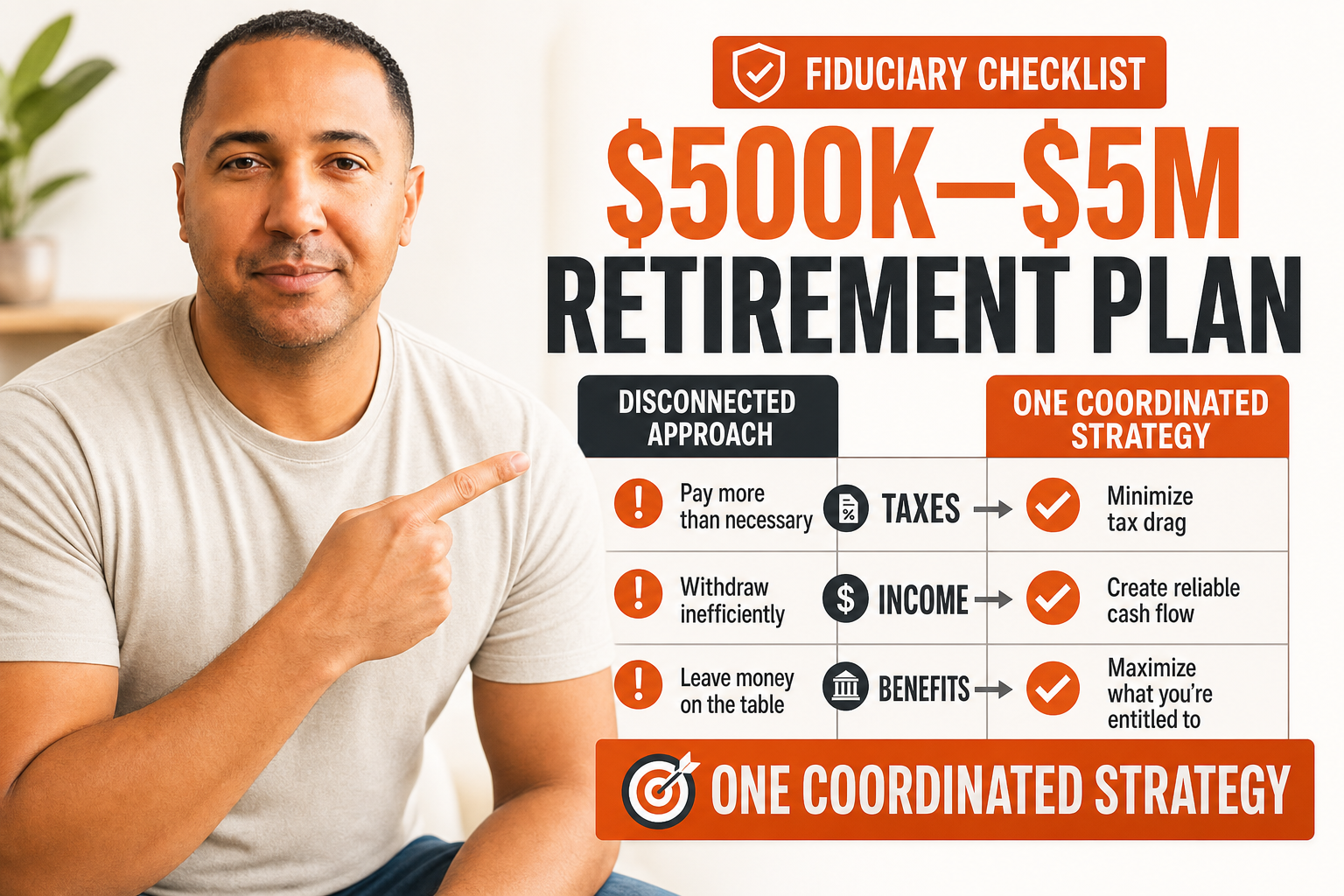
This guide is a pillar roadmap for retirement planning for households with $500K to $5M in investable assets. It’s written for smart people who don’t want jargon, don’t want hype, and don’t want a pile of disconnected tips. You want a coordinated plan that holds up.
The core idea is simple: in retirement, the “best” strategy is rarely the one that maximizes one thing (like the biggest Social Security check or the lowest tax bill this year). The best strategy is the one that coordinates everything so your income is durable, your taxes are managed over decades, and your plan stays flexible.
Income planning for $500K–$5M households is a coordination problem
If you’re in the $500K–$5M range, you’re in a zone where you have options—and options create tradeoffs.
You may have:
A meaningful IRA/401(k) balance that will eventually force taxable withdrawals (RMDs)
A taxable brokerage account with embedded capital gains
Some Roth dollars (or the ability to create them)
Social Security that matters, even if you don’t “need” it
A pension, deferred comp, rental income, or business sale proceeds
Healthcare decisions that can change your taxes (Medicare IRMAA) and your cash flow
Estate goals that add another layer (beneficiaries, trusts, charitable giving)
The mistake I see most often is not “bad investing.” It’s uncoordinated decisions:
Claiming Social Security without checking what it does to your tax bracket and Medicare premiums
Taking IRA withdrawals because it feels “safe,” then discovering you inflated future RMDs and taxes
Doing Roth conversions aggressively and accidentally triggering Medicare IRMAA surcharges
Holding a conservative portfolio to “protect principal,” then withdrawing too much from too little growth
Chasing yield for income and taking risks you didn’t intend (credit risk, concentration risk)
Treating taxes as an April problem instead of a lifetime problem
A good retirement plan for affluent retirees isn’t a binder. It’s a living system with rules: how you spend, where you pull money from, how you manage taxes, and how you adjust when markets or laws change.
The framework I use with clients at Grape Wealth Management
When a household comes to me with $500K–$5M invested, I’m not trying to impress them with complexity. I’m trying to reduce complexity into a decision-by-decision roadmap.
Here’s the framework we use, and it’s the structure of this article:
Define spending and guardrails (so the portfolio has a job description)
Map income sources and timing (so you know what’s “guaranteed” vs market-dependent)
Design a tax-aware withdrawal order (so you don’t overpay over your lifetime)
Coordinate Social Security and Medicare (because benefits and premiums are tied to income)
Set portfolio risk and rebalancing rules (so you can fund withdrawals through real markets)
Plan for RMDs, charitable giving, and estate coordination (so taxes and legacy aren’t accidental)
Stress-test and update annually (because retirement is a long project)
If you want deeper dives on individual pieces, I’ll reference supporting articles from our Retirement Planning for $500K–$5M Households cluster along the way.
Step 1: Turn “I think we’re fine” into a spending plan with guardrails
Most retirees don’t actually want a “budget.” They want permission to spend.
So we start with a simple question: What does your portfolio need to produce for you, after accounting for guaranteed income?
In plain English, your retirement income usually comes from three buckets:
Guaranteed income: Social Security, pensions, some annuities
Portfolio income: dividends, interest, and withdrawals from investments
One-time or irregular sources: home sale, inheritance, business sale, part-time work, Roth conversions (not income, but a tax move that affects cash flow)
The guardrail concept matters because retirees with substantial assets often do one of two things:
They underspend for years because they fear running out, then later realize they could have enjoyed more.
They overspend early (often unintentionally) because withdrawals feel small relative to the balance—until a down market hits.
A practical way to set guardrails
I like to build the plan around three numbers:
Baseline spending: what you want to spend in a normal year
Floor spending: what you could live on if markets are rough for a while
Stretch spending: what you’d love to do in great years (travel, gifting, big projects)
Then we connect those numbers to a withdrawal policy.
Example: If your baseline requires $120,000 per year and Social Security covers $55,000, the portfolio needs to fund about $65,000 (before taxes). That’s the number we design around.
This is where high-balance mistakes show up. A household with $2 million might assume $120,000 is “only 6%” and therefore fine. But what matters is not one year. What matters is the combination of:
Withdrawal rate over decades
Taxes (which can make $65,000 of spending require $80,000+ of withdrawals)
Market sequence risk (bad returns early in retirement)
Inflation and healthcare costs
The goal isn’t to guess the future perfectly. The goal is to define rules now so you’re not improvising later.
Step 2: Map your income sources and timing before you pick investments
Once spending is defined, we map income sources with dates.
This sounds basic, but it’s where affluent retirees gain clarity fast. You can’t build a durable plan if you don’t know what turns on when.
Here’s what we lay out on one page:
Social Security start dates (each spouse)
Pension start date and survivor option (if applicable)
Required Minimum Distribution (RMD) start year for pre-tax retirement accounts
When Medicare begins (usually 65) and whether you’re using ACA coverage before then
Large one-time cash needs (new roof, car, helping adult children, buying a second home)
Expected “tax events” (selling a business, selling a concentrated stock position, real estate sale)
Two underrated points for $500K–$5M households
First, Social Security still matters.
I hear: “We saved enough; Social Security is just extra.” But Social Security is inflation-adjusted income that lasts as long as you do. Even for high-net-worth retirees, it can meaningfully reduce how much you need to pull from the portfolio in your 70s, 80s, and 90s.
Second, RMDs are not just a nuisance.
RMDs can push you into higher tax brackets later, increase how much of your Social Security is taxed, and trigger Medicare IRMAA surcharges. If you have a large IRA/401(k), RMD planning is not optional—it’s part of retirement planning for households with $500K to $5M in investable assets.
For a deeper dive on RMD tactics, see /post/rmd-strategies-large-ira-401k.
Step 3: Build a tax-aware withdrawal order (and stop thinking in “accounts”)
Most people think in accounts:
“This is our IRA.”
“This is our brokerage account.”
“This is our Roth.”
In retirement, you need to think in tax characteristics:
Pre-tax money (IRA/401(k)): withdrawals are taxed as ordinary income
After-tax brokerage money: you may owe capital gains tax when you sell investments
Roth money: qualified withdrawals can be tax-free
The goal is not to pay the least tax this year.
The goal is to pay the least tax over your lifetime while keeping flexibility.
Why “lowest tax this year” can be expensive later
If you retire at 62 and delay Social Security until 70, you may have several years with unusually low taxable income.
Those years are valuable.
If you fill them with “no income” because you live off cash and brokerage accounts, you may be wasting low tax brackets that could have been used for:
Roth conversions (moving money from IRA to Roth and paying tax now at a controlled rate)
Strategic IRA withdrawals before RMD age to reduce future forced income
Capital gain harvesting in taxable accounts (realizing gains at favorable rates when possible)
This is the heart of tax planning for high-net-worth retirees: you’re managing brackets over time.
A simple withdrawal order concept (with a big caveat)
You’ll see generic rules online like:
“Spend taxable first, then IRA, then Roth.”
Sometimes that’s fine. Often it’s not.
A more realistic approach is:
Use taxable assets and/or IRA withdrawals to fill a target tax bracket each year
Use Roth strategically for flexibility (large one-time expenses, market downturns, or to avoid IRMAA)
Keep an eye on future RMDs and the tax torpedo (when Social Security becomes more taxable as other income rises)
This is exactly what we cover in our supporting guide: /post/tax-efficient-withdrawal-strategies-retirement.
A realistic example: $2.4 million household, early retirement window
Let’s say Mark (64) and Elena (63) retire with:
$1.6M in traditional IRAs/401(k)s
$600k in a taxable brokerage account
$200k in Roth IRAs
They want $140,000 per year of after-tax spending.
They plan to delay Social Security to 70 because longevity runs in the family.
If they simply spend the taxable account for six years and avoid IRA withdrawals, their IRA keeps growing. Then RMDs begin later and can be large. Add two Social Security checks, and suddenly they’re in a higher bracket in their 70s than they ever were while working.
A coordinated approach might look like:
From 64–70, intentionally withdraw and/or convert a planned amount from IRA each year to “fill up” a reasonable tax bracket
Use taxable assets for the rest of spending needs
Keep Roth as a pressure-release valve for years when income spikes (large gains, a home sale, or a surprise tax bill)
The point isn’t that everyone should do Roth conversions. The point is that your 60s can be a rare tax-planning window—and high-balance households often miss it.
Step 4: Social Security and Medicare are connected to your tax plan (whether you like it or not)
Social Security optimization for wealthy retirees is not about gaming the system. It’s about making a high-impact decision with clear tradeoffs.
Social Security basics in plain English
You can claim as early as 62 (reduced benefit) or as late as 70 (increased benefit). For many higher earners, delaying increases the monthly check meaningfully.
What’s often misunderstood:
Social Security is longevity insurance. If you live a long time, delaying can pay off.
It can reduce portfolio withdrawals later. A bigger check in your 70s and 80s can take pressure off investments.
It interacts with taxes. The more other income you have, the more of your Social Security can become taxable.
For a deeper guide, see /post/social-security-optimization-wealthy-retirees.
Medicare and IRMAA in plain English
Medicare premiums are not the same for everyone.
If your income is above certain thresholds, Medicare adds a surcharge called IRMAA (Income-Related Monthly Adjustment Amount). It’s based on your tax return from two years prior.
That means a big Roth conversion, a large capital gain, or a one-time IRA withdrawal can raise Medicare premiums later.
This is why Medicare planning for retirees with significant assets is not just “pick a plan.” It’s part of the tax plan.
For a deeper dive, see /post/medicare-planning-irmaa-high-assets.
The tradeoff retirees need to see clearly: Roth conversions vs IRMAA
Roth conversions can reduce future RMDs and create tax-free flexibility.
But conversions increase taxable income today, which can:
Push you into a higher tax bracket
Trigger IRMAA surcharges
Increase taxation of Social Security (if you’re already claiming)
So the right question isn’t “Should we do Roth conversions?”
The right question is: “How much conversion makes sense in our bracket, given our Medicare timeline and future RMD problem?”
We cover IRMAA-aware conversion timing in /post/roth-conversions-irmaa-early-retirement.
Step 5: Portfolio risk in retirement is different—sequence risk is the real villain
Most retirees think risk means volatility: “I don’t want my account to go down.”
But the risk that breaks retirement plans is usually sequence-of-returns risk.
Sequence risk in plain English
If markets drop early in retirement and you’re withdrawing at the same time, you can permanently damage the portfolio. You’re selling more shares when prices are low, leaving fewer shares to recover.
This is why two retirees can have the same average return over 20 years but very different outcomes depending on when the bad years happened.
For a deeper explanation and portfolio design ideas, see /post/asset-allocation-sequence-risk-affluent-retirees.
What affluent retirees often get wrong about “playing it safe”
A common high-balance mistake is going too conservative too early.
It feels responsible. But if your spending horizon is 25–35 years, you still need growth. Inflation is not theoretical. Healthcare costs are not theoretical. And a portfolio that can’t grow may force you to cut spending later.
The other common mistake is chasing income.
People want dividends and interest so they can “live off the income.” But high yield can hide risk:
Long-term bonds can drop when interest rates rise
High-dividend stocks can be concentrated in a few sectors
Credit-heavy funds can get hit in recessions
A better approach is to separate “income” from “withdrawals.”
Your portfolio doesn’t need to throw off a certain yield. It needs to support a withdrawal plan.
A practical way to structure risk for retirement withdrawals
I prefer a structure that answers three questions:
What money do you need in the next 12–24 months?
What money do you need in the next 3–7 years?
What money is truly long-term (7+ years)?
This naturally leads to a diversified portfolio with a cash and high-quality bond reserve for near-term spending, and equities for long-term growth.
Then we add rules:
Rebalancing rules (so you’re not guessing)
A plan for what to do in a down market (so you’re not selling stocks in panic)
A spending adjustment policy if markets are rough for an extended period
This is not about predicting markets. It’s about building a system that can fund your life through real markets.
Step 6: RMDs, charitable giving, and estate planning should be coordinated, not bolted on
Households with $500K–$5M often have two simultaneous goals:
Fund retirement confidently
Leave money to children, charities, or both
The mistake is treating estate planning as separate from tax planning.
RMD basics in plain English
RMDs are required minimum distributions from most pre-tax retirement accounts once you reach the required age. The IRS forces you to take taxable income whether you need it or not.
If you have a large IRA, RMDs can become a tax engine later in life.
That’s why RMD strategies for large retirement accounts matter. See /post/rmd-strategies-large-ira-401k.
Charitable giving strategies that can reduce taxes
If you’re charitably inclined, one of the most powerful tools after RMD age is the Qualified Charitable Distribution (QCD).
In plain English: you can send money directly from an IRA to a qualified charity, and it can count toward your RMD without showing up as taxable income (subject to rules).
Why that matters:
Lower taxable income can reduce Medicare IRMAA exposure
Lower taxable income can reduce how much of your Social Security is taxed
It can be more efficient than writing a check and trying to itemize deductions
Other charitable tools (like donor-advised funds) can be helpful in high-income years (business sale, large capital gain), but they need to be coordinated with your broader plan.
Estate planning for retirees with substantial wealth: what’s essential
I’m not an attorney, but as a fiduciary advisor I can tell you what tends to break in real life:
Beneficiary forms don’t match the will or trust
Old ex-spouses are still listed on retirement accounts
Children inherit a large pre-tax IRA and face big tax bills during their peak earning years
No plan exists for incapacity (powers of attorney, healthcare directives)
A good estate plan coordinates:
Account titling and beneficiaries
Tax characteristics of what each heir receives (Roth vs pre-tax vs taxable)
Charitable intent (if any)
A realistic plan for who will manage things if you can’t
In the $500K–$5M range, you don’t need complexity for its own sake. You need alignment.
The retiree questions that matter most right now (and straight answers)
How can I optimize my Social Security benefits given my substantial retirement savings?
Don’t treat Social Security as “extra.” Treat it as a lifelong, inflation-adjusted income stream.
For many affluent couples, the highest-impact decision is coordinating claiming ages between spouses to protect the survivor. Delaying the higher earner’s benefit often increases the survivor’s income later.
The right claiming strategy depends on health, other income, tax brackets, and whether you’re using the 60s as a Roth conversion window. Start with scenarios, not rules of thumb. See /post/social-security-optimization-wealthy-retirees.
What tax strategies should I consider to minimize taxes on my retirement income?
Think lifetime, not yearly.
The most common high-impact strategies in this asset range are:
Tax-bracket management (intentionally filling brackets in low-income years)
Roth conversion planning (especially before RMDs and before Social Security starts)
Tax-efficient withdrawal sequencing across account types
Capital gain planning in taxable accounts
Charitable strategies like QCDs and donor-advised funds when appropriate
But the key is coordination. A Roth conversion that looks smart in a vacuum can be less smart if it triggers IRMAA or pushes you into a bracket you could have avoided.
Start here: /post/tax-efficient-withdrawal-strategies-retirement and /post/roth-conversions-irmaa-early-retirement.
How do required minimum distributions affect my retirement planning?
RMDs can turn into a “tax wave” later.
If you have a large IRA/401(k), RMDs can:
Increase your tax bracket
Increase taxation of Social Security
Trigger Medicare IRMAA surcharges
Reduce flexibility for Roth conversions later
Good planning often means addressing the RMD issue before it arrives, using controlled withdrawals, conversions, and charitable strategies. See /post/rmd-strategies-large-ira-401k.
What estate planning steps are essential for preserving my wealth for future generations?
At minimum, make sure:
Your beneficiaries are correct on every retirement account and life insurance policy
Your will and/or trust matches your real-world accounts
You have durable power of attorney and healthcare documents
You’ve discussed the plan with the people who will execute it
Then coordinate taxes: who inherits pre-tax money, who inherits Roth, and whether charitable giving should be part of the plan.
How can I ensure my Medicare coverage meets my healthcare needs in retirement?
Medicare planning is both coverage and cost.
Coverage: choose between Original Medicare plus a supplement and Part D, or Medicare Advantage, based on your doctors, travel habits, and risk tolerance for out-of-pocket costs.
Cost: manage IRMAA exposure by coordinating taxable income (Roth conversions, gains, IRA withdrawals) because Medicare premiums are income-tested.
See /post/medicare-planning-irmaa-high-assets.
The high-balance mistakes I’d avoid if you’re $500K–$5M
I’m going to be direct here. These are common, expensive mistakes I see among retirees with meaningful assets.
Overrating “income investing”
A portfolio built to maximize yield can quietly increase risk and reduce flexibility. Your goal is sustainable spending, not a dividend trophy.
Underrating tax bracket management
Many households spend years in low brackets early in retirement and don’t use them. Then they get hit with RMDs and higher brackets later.
Claiming Social Security without running the tax and survivor scenarios
This is a permanent decision. You don’t need a perfect answer, but you do need to see the tradeoffs.
Doing Roth conversions without Medicare awareness
Conversions can be great. They can also raise Medicare premiums later. The right amount matters.
Letting a concentrated position linger
If a single stock or sector became a big part of your net worth, you may be carrying more risk than you think. Diversification is not about being fancy; it’s about making sure one company can’t rewrite your retirement.
Treating estate planning as paperwork instead of a coordinated plan
Beneficiary mistakes and mismatched documents are painfully common—and avoidable.
A practical action list to coordinate your retirement income plan
If you’re within five years of retirement or already retired, here’s a clean set of actions that creates clarity quickly. You don’t need to do everything at once, but you do need a sequence.
- Build your one-page retirement income map
List each income source, start date, and whether it’s guaranteed or market-based.
Include Social Security, pensions, rental income, and expected RMD start year.
- Define spending guardrails
Write down baseline, floor, and stretch spending.
Decide what would cause you to temporarily reduce spending (a market decline, a large unexpected expense).
- Inventory accounts by tax type
How much is in pre-tax (IRA/401(k))?
How much is in taxable brokerage?
How much is in Roth?
This is the foundation for tax-efficient withdrawal strategies.
- Estimate your future RMD problem
You don’t need perfect math. You need a directional view.
If your IRA is large today, assume it may be larger later unless you have a plan.
- Run a Roth conversion and withdrawal sequencing scenario
Model at least two paths:
Minimal conversions now, larger RMDs later
Planned conversions now (IRMAA-aware), smaller RMDs later
Use /post/roth-conversions-irmaa-early-retirement and /post/tax-efficient-withdrawal-strategies-retirement as guides.
- Coordinate Social Security with the tax plan
Don’t pick a claiming age until you’ve seen how it affects taxes, Medicare, and survivor income.
Reference: /post/social-security-optimization-wealthy-retirees.
- Make Medicare an intentional decision
Choose coverage based on your doctors and travel.
Then check IRMAA exposure based on your planned income.
Reference: /post/medicare-planning-irmaa-high-assets.
- Set portfolio rules that match withdrawals
Decide how much cash and high-quality bonds you want for near-term spending.
Set rebalancing rules.
Decide what you will do in a down market before it happens.
Reference: /post/asset-allocation-sequence-risk-affluent-retirees.
- Align beneficiaries and charitable intent
Review beneficiary forms.
If you give to charity, evaluate QCDs (if eligible) and whether a donor-advised fund fits your situation.
If you want this coordinated as one plan, let’s do it together
If you have $500,000 to $5 million in investable assets, the biggest value isn’t a hot investment idea. It’s coordination: withdrawals, taxes, Social Security, Medicare IRMAA, RMDs, and portfolio risk working as one system.
At Grape Wealth Management, we do this as fiduciaries. That means the advice is built around your best interest, with clear tradeoffs and a plan you can actually follow.
Schedule a Retirement Income & Tax Coordination Review here: http://grapewealthmanagement.salesmate.io/meetings/#/grapewealthmanagement/user/1